

Deal Analyser: Most Deals Fail on the Numbers, Not the Property
Most property deals don't fail because they're bad — they fail because the numbers were wrong. A free UK calculator for buy-to-let, BRRR, HMO and business-acquisition deals.
Updated 31 August 2026
Disclaimer: This article is educational only. Deal Analyser gives estimates based on your inputs and is not a substitute for advice from a qualified broker, accountant, solicitor or surveyor. Property investment involves risk, and past performance does not indicate future results.
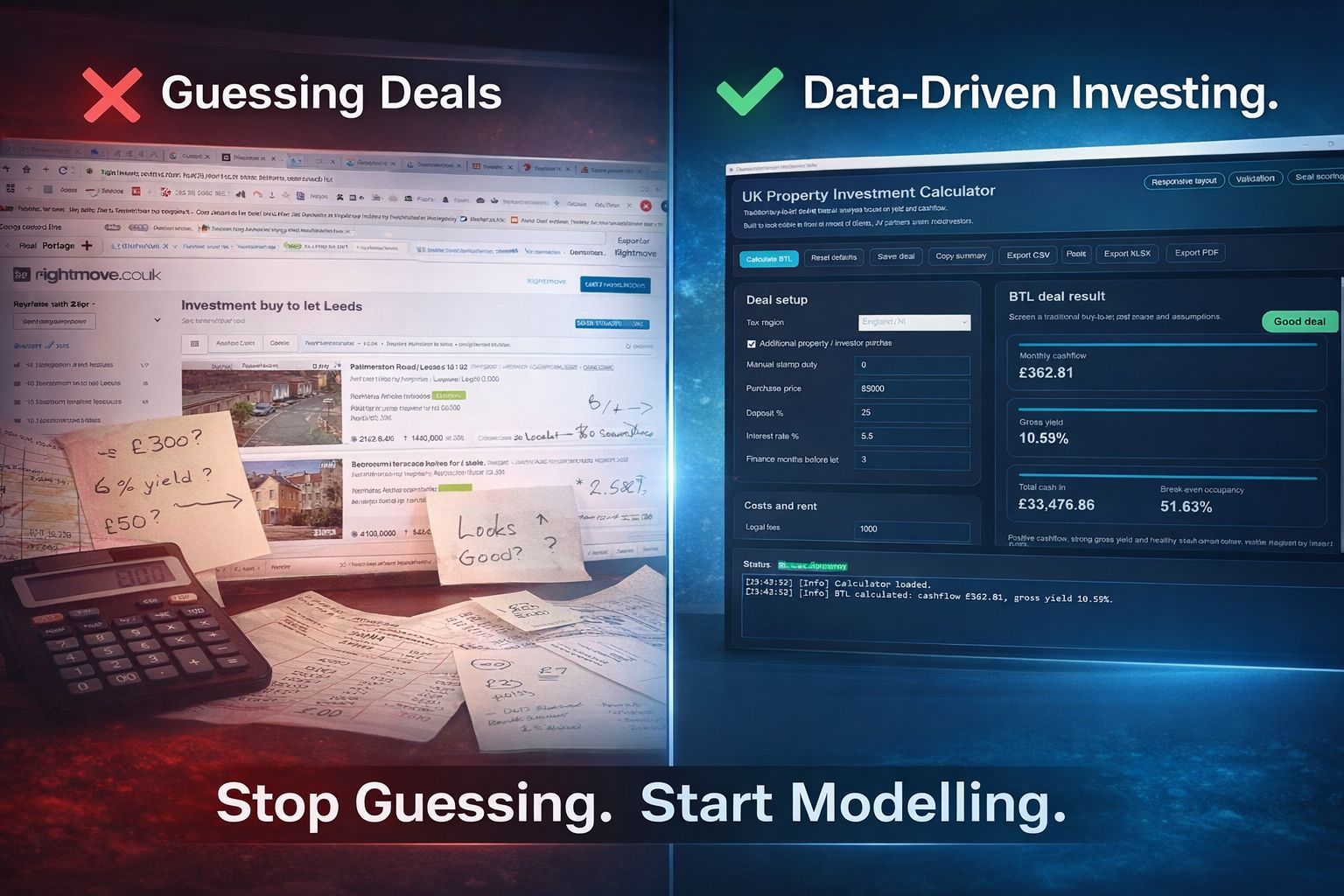
Most property deals don’t fail because they’re bad deals.
They fail because investors didn’t run the numbers properly — or didn’t run them at all.
Guessing yields, ignoring actual costs, underestimating voids, overestimating rental income, and forgetting about tax all look like optimism until the deal is done and the numbers don’t work.
You don’t have a deal problem. You have a clarity problem.
What a good deal calculator actually does
A calculator isn’t magic. It’s a structured way of asking the right questions before you commit money.
For a buy-to-let, the right questions are:
- What’s the actual gross yield at this price and rent?
- What’s the net yield after mortgage, costs and voids?
- What’s the monthly cashflow — really?
- At what occupancy does this deal break even?
- What happens if interest rates go up 2%?
- What happens if the rent drops 10%?
For a BRRR deal:
- How much cash stays in the deal after refinance?
- What’s the return on equity left in?
- Does the refinance actually work at a realistic valuation?
For an HMO:
- What does the rent roll actually produce after management, utilities and bills?
- What does this property value at a commercial yield?
- What’s the ROI on total cash invested?
And if what you’re buying is a business rather than a property:
- What does the funding stack actually look like once every source is stacked up?
- Does the trading profit cover the debt service, with margin left over?
- What is the highest price this structure could sustain — and what stops it going higher?
These aren’t hard questions. But guessing the answers is how investors end up owning properties, or businesses, that don’t stack.
Deal Analyser
I built Deal Analyser for one purpose: to quickly determine whether a deal is worth serious attention or should be passed on.
It has five modes.
BTL (Buy-to-Let)
- Monthly and annual cashflow
- Gross yield and cash-on-cash return
- Break-even occupancy rate
- Full cost breakdown including stamp duty
BRRR (Buy, Refurb, Rent, Refinance)
- Cash left in the deal after refinance
- ROCE (return on capital employed)
- Yield on purchase vs yield on end value
- Stress testing the refinance outcome
HMO (House in Multiple Occupation)
- Full room rent analysis
- Management fee, utilities and bills included
- ROI on total cash invested
- Commercial valuation estimate at a target yield
Business acquisition
- The full funding stack, and what it costs to service
- DSCR and Debt/EBITDA
- Stress testing against worse trading
- Risk assessed across four separate dimensions, each reported on its own rather than collapsed into one score
Reverse deal
- Instead of “does this price work?”, it answers “what is the highest price that could work?”
- You supply the funding capacity and the safety margins you insist on, and it solves for the maximum sustainable price
- It also names the constraint that stops it going higher, which is the part that tells you what to negotiate
Stamp duty covers England, Northern Ireland and Wales, including the additional-property surcharge.
One deliberate behaviour is worth knowing about before it surprises you: when a refinance returns more cash than you put in, the usual return-on-capital formula divides by a negative number and produces a confident-looking figure that means nothing. Deal Analyser shows N/A there instead, and reports the extracted cash as its own separate figure. The reasoning behind that is its own note.
How to use it properly
Running the numbers once and calling it analysis isn’t enough. The professional approach:
- Run the deal at your actual assumptions
- Stress test: rates +1%, rents -10%, refurb +10%
- Calculate break-even occupancy — can this deal survive partial voids?
- Ask: if conditions get worse, would I still buy?
If the deal only works under optimistic assumptions, it doesn’t work.
What Deal Analyser doesn’t do
It doesn’t replace professional advice. It doesn’t account for your personal tax position, your specific lender’s criteria, local planning restrictions, or the condition of an individual property. It gives you a structured starting point — not a decision.
Before committing to any purchase:
- Speak to a mortgage broker who understands investor finance
- Speak to an accountant about tax implications (SDLT, income tax, CGT)
- Get a survey done
- Have a solicitor review the title
Deal Analyser gives you clarity on whether the numbers make sense. The professionals help you execute properly.
Try it
It’s free, requires no login, and works on mobile and desktop. Everything runs in your browser — nothing you type is sent anywhere. Deals can be saved locally, reopened, compared side by side, exported as JSON or CSV, or printed.
The full build history and the design decisions behind it are on the Deal Analyser project page.
The difference between investors who build successful portfolios and those who don’t isn’t access to better deals. It’s how rigorously they analyse the ones they look at.
Run the numbers. Stress test the assumptions. Then decide.
Free Deal Analyser
Run the numbers before you fall in love with the deal.
Use the free Deal Analyser to test BTL, BRRR, HMO and business acquisition scenarios — cashflow, yield, SDLT, DSCR and stress checks, all in one place.
Open Deal Analyser