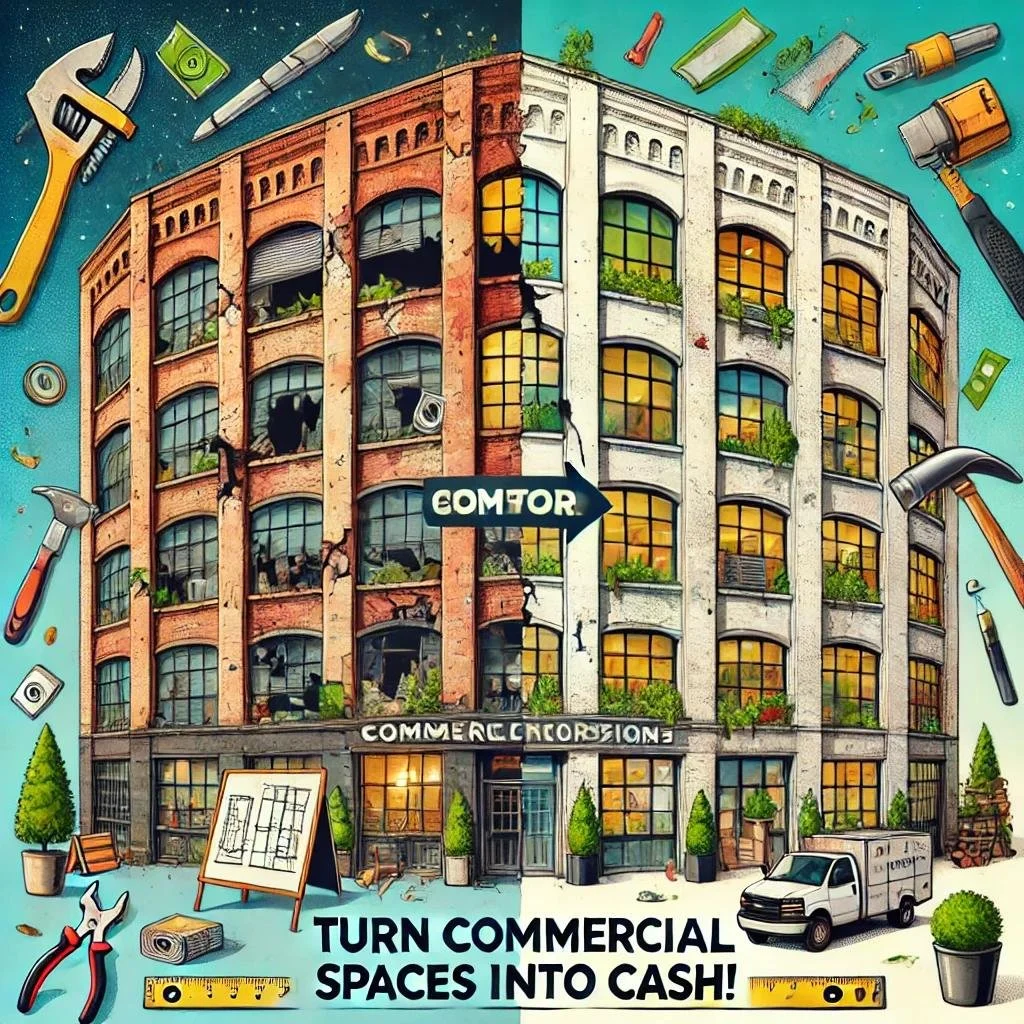
How to Make Money with Commercial Conversions: A Beginner's Guide
Commercial conversions — turning offices, shops or warehouses into residential — can be profitable when the numbers work. Here's a plain-English introduction to how the process works.
Disclaimer: This article is general information only and is not financial, mortgage, tax, legal or investment advice. Planning and permitted development rules change, vary by location, and depend on the specific property and proposed use. Always consult a solicitor, planning consultant, and qualified advisers before committing to any development project.
Commercial conversion — turning an old office, shop, or warehouse into residential space — offers a route into development that doesn’t always require starting from the ground up. When the deal is right and the process is managed properly, it can be profitable. When it isn’t, it’s an expensive lesson.
This is an introduction for investors who are curious about the model but haven’t done one yet.
What a commercial conversion involves
You acquire a commercial property — something that was previously used as offices, retail, light industrial, or storage — and convert it into one or more residential units. The appeal is straightforward: commercial properties can be cheaper per square foot than residential, and the conversion adds significant value.
The catch: conversion is more complex than a standard refurbishment. It involves planning considerations, building regulations, structural assessment, and often a different finance process.
Step 1: Find the right property
Not every commercial property is worth converting. Look for:
- Underused or vacant commercial space in areas with residential demand
- Buildings with good bones but poor current use
- Properties with genuine planning potential — not just optimistic thinking
Location matters as much in conversions as in any other property investment. An office block in a town centre with active residential demand is a very different proposition to a retail unit on a failing high street.
Step 2: Understand permitted development rights
Some commercial-to-residential conversions don’t need full planning permission because they fall under permitted development (PD) rights. Class MA permitted development allows certain commercial and retail buildings to be converted to residential use without a full planning application — subject to conditions and a prior approval process.
However:
- PD rights are complex and change. What was permitted in 2022 may not be in 2026.
- Local authorities can remove PD rights in specific areas.
- There are conditions on flood risk, listed buildings, article 4 directions, and other matters.
Always verify the planning position with a planning consultant or solicitor before exchanging contracts. Do not assume PD applies because it applied to a similar property nearby.
Step 3: Run the numbers before you commit
Before doing any significant work:
- Purchase price
- Estimated conversion cost (structural, M&E, fit-out)
- Contingency (typically 15–20% on a conversion)
- Finance costs (bridging, development finance)
- Professional fees (architect, structural engineer, planning consultant, solicitor)
- Void period and holding costs post-completion
- Projected GDV (Gross Development Value) — what will the units sell or let for?
If the numbers don’t work before you start, they won’t work at the end. Conversions rarely get cheaper as they progress.
Step 4: Get the right team
Commercial conversions need experienced professionals who have done this type of work before:
- Architect — to design the conversion, manage planning, and oversee building regulations
- Structural engineer — older commercial buildings often need assessment
- Builder/main contractor — with conversion experience, not just domestic refurb
- Planning consultant — if full planning permission is needed
The single most expensive mistake in conversions is appointing people who haven’t done one before. Their learning curve comes out of your contingency.
Step 5: Understand the finance
Commercial conversions typically require:
- Bridging finance for the acquisition and conversion phase
- Development finance for larger schemes (usually available from 65% of GDV)
- A clear exit strategy: either selling the units or refinancing onto buy-to-let mortgages
Some high street lenders won’t touch converted commercial properties. Speak to a broker who specialises in development finance before you start, not after you own the building.
Step 6: Sell or rent the finished units
Your exit depends on your strategy and the market:
- Selling generates capital but ends the income stream
- Refinancing and renting creates ongoing income but requires a lender willing to accept the property type
Factor whichever exit you’re planning into your numbers from the beginning. Changing strategy mid-project is possible but expensive.
Is it right for you?
Commercial conversion isn’t a shortcut to property profit. Done well, with the right property, the right team, and the right numbers, it can work. Done poorly — or on the wrong building — it’s a slow and expensive drain.
Before committing, speak to someone who has done a commercial conversion in the area you’re targeting. The local planning and valuation context matters enormously.
Related resources: