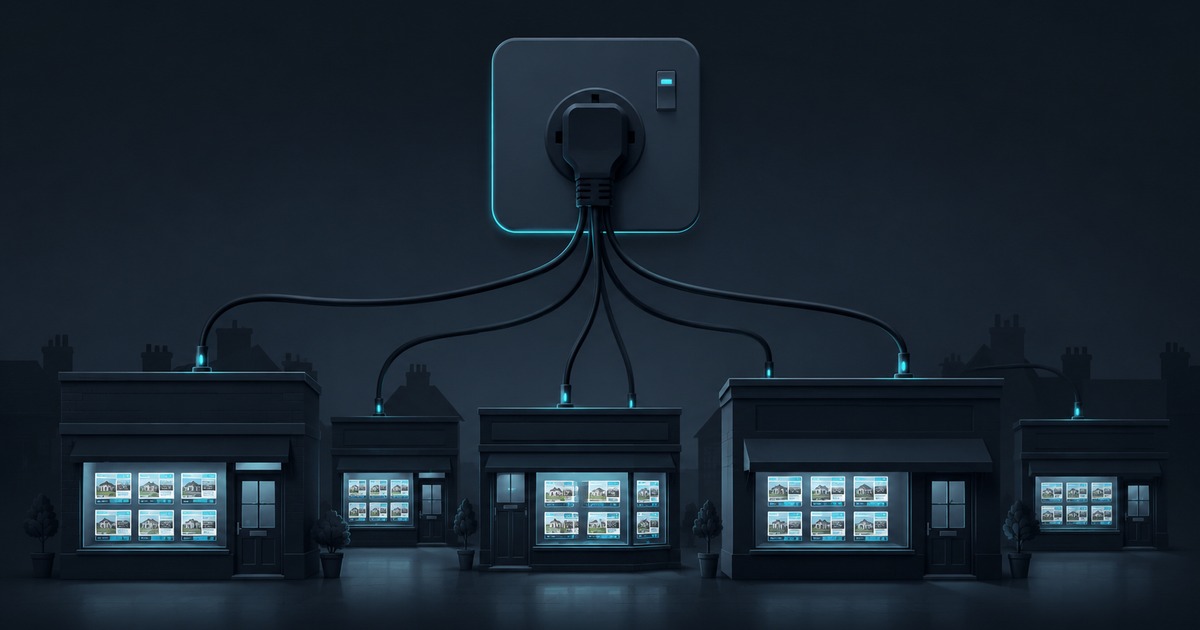
Rightmove's £1.5bn Legal Claim Isn't the Real Story. Dependency Is.
A reported £1.5bn legal claim against Rightmove made headlines. The bigger story for property businesses is what it reveals about how dependent they've become on platforms they don't own.
A note on the figures: The £1.5bn claim figure and the number of agencies involved come from PropertyWire’s reporting on a Competition Appeal Tribunal case. I haven’t independently verified these numbers — treat them as reported, not as established fact, and check the current status of the case before quoting it elsewhere.
PropertyWire reported that Rightmove is facing a legal claim worth a reported £1.5bn at the Competition Appeal Tribunal, over alleged excessive subscription fees — with more than 250 agencies said to be considering joining the case.
That’s the headline. It’s not the story that matters to you.
The real story: you’ve outsourced your oxygen
Whatever happens with that claim, here’s the uncomfortable question it raises: how much of your business depends on a platform you don’t own and can’t control?
Most agencies — and plenty of investors and sourcers — have quietly outsourced three things to single platforms:
- Attention. Buyers and tenants find you through someone else’s homepage.
- Lead flow. Enquiries arrive through someone else’s form, with someone else’s branding around them.
- Deal visibility. Your stock is only as visible as the platform’s algorithm decides it should be.
I call that renting oxygen. It works, right up until the landlord changes the rent — or the terms, or the algorithm, or the relationship.
Why this should worry you, regardless of the legal outcome
Three consequences follow from heavy platform dependency, and none of them need a tribunal ruling to bite:
1. Weaker margins. When most of your enquiries come through one paid channel, that channel can — and eventually will — price in your dependency. You end up funding your own replaceability.
2. Softer decisions. When visibility is rented, you start making business decisions to please the platform’s algorithm rather than your actual clients. That’s backwards.
3. Fragile growth. A business built on one channel doesn’t grow — it waits. One policy change, fee increase or visibility shift, and your pipeline can drop overnight, through no fault of your own.
What to do instead — a five-point framework
You don’t need to quit the major portals. You do need to stop being owned by them.
1. Run a dependency audit For the last twelve months, work out what percentage of your enquiries, valuations and instructions came from each source — portals, referrals, repeat clients, direct enquiries, social, your own website. If one channel accounts for more than half, you have a concentration problem, not a strategy. (For ideas on tools that help you build channels you actually own, the Recommended Resources page is a curated, no-affiliate-link starting point.)
2. Separate traffic from pipeline Traffic is attention. Pipeline is relationships you can reach without anyone else’s permission — your own list, your own contacts, your own database. Traffic comes and goes. Pipeline compounds.
3. Build more than one channel, deliberately Local SEO, your own site, referral relationships, direct outreach to landlords and investors, content that ranks on its own. None of these need to be huge individually. Together, they mean no single platform can switch off your business.
4. Treat your marketing infrastructure like an asset, not a cost Your website, your email list and your reputation with past clients are things you own. Portal subscriptions are things you rent. Invest accordingly. If you haven’t built the system to manage that asset yet, that’s the actual starting point — not another subscription.
5. Get comfortable being found off-platform Word of mouth, direct enquiries, and people who type your name into a search bar rather than browsing a portal — that’s the most valuable kind of demand there is, because nobody else can switch it off.
The contrast that matters
Picture two agencies in the same town. One gets eighty percent of its instructions from a single portal. The other gets a third from the portal, a third from its own site and database, and a third from referrals and repeat business.
The portal could change its pricing tomorrow and only one of those businesses would need to panic.
The bottom line
Don’t build your business on something you don’t own. Whoever controls your visibility will, eventually, start pricing your dependency on them.
Use the platforms. Just don’t let them use you.